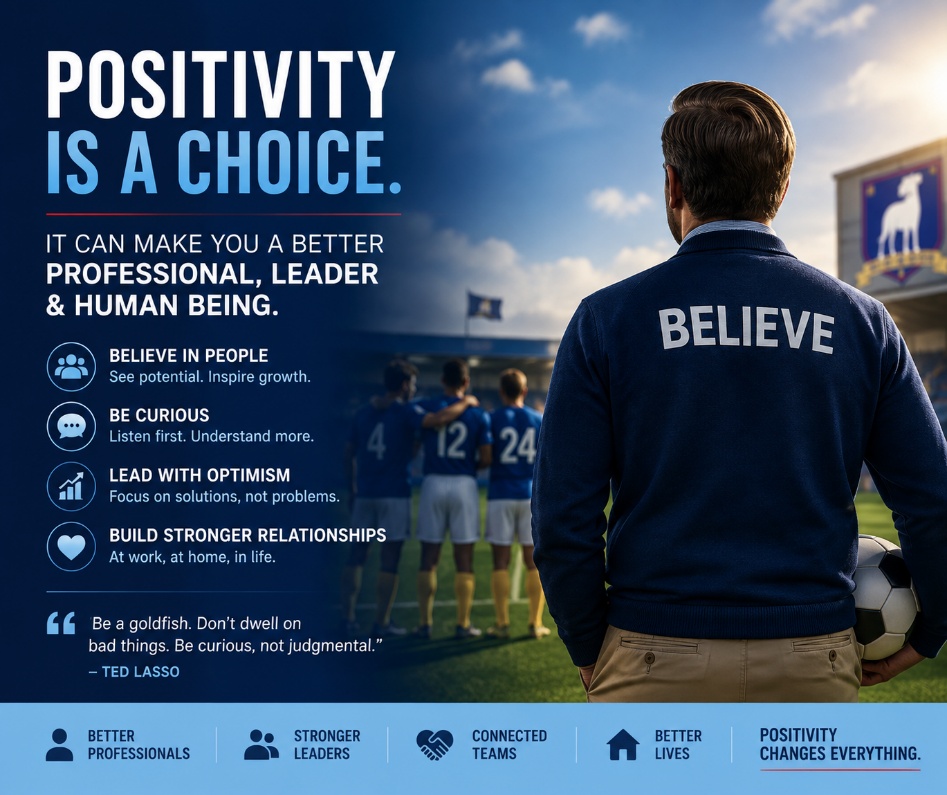
Let's be honest: the business world has no shortage of leadership books, podcasts, seminars and consultants telling us how to become better leaders.
And then along came a mustachioed American football coach who knew almost nothing about English soccer and somehow taught millions of people more about leadership than many corporate training programs ever have.
I'm talking, of course, about Ted Lasso.
At first glance, Ted's relentlessly positive attitude can seem almost unrealistic. Who walks into a difficult situation with a smile, a box of biscuits and an unwavering belief that everything is going to work out?
But that's precisely what makes Ted's character so interesting.
His positivity isn't really about being happy all the time. It's about choosing how you respond to people and circumstances — even when things aren't going your way.
And that is a leadership lesson worth paying attention to.
Positivity Isn't Pretending Everything Is Great
One of the biggest misconceptions about positivity is that it means ignoring problems.
It doesn't.
Ted faces failure, conflict, rejection, personal struggles and plenty of people who think he's an idiot. He doesn't simply smile, throw out a motivational quote and pretend everything is fine.
In fact, one of the most compelling aspects of his character is that he eventually acknowledges his own struggles and accepts that he needs help.
That's an important distinction for leaders.
Positive leadership isn't pretending there are no problems. It's believing that problems can be solved.
A positive leader can say, "We've got a serious problem," while simultaneously saying, "Let's figure out what we're going to do about it."
That mindset can completely change the atmosphere of a workplace.
People Perform Differently When They Believe Someone Believes in Them
Ted's greatest leadership skill may not be his optimism. It may be his ability to make people believe that they are capable of more than they currently believe themselves to be.
He sees potential in people who have been overlooked, dismissed or written off.
That's powerful.
Research and leadership commentary surrounding the character have repeatedly highlighted Ted's ability to create environments where people feel valued, supported and motivated. Arizona State University has even examined what it calls the "Lasso Effect" — the idea that a leader's belief and emotional energy can spread throughout a team.
Think about that in your own workplace.
Who is the person who rarely speaks in meetings?
Who is the employee who has made a few mistakes and now seems hesitant to take a risk?
Who is the person doing an important job that nobody seems to notice?
A Ted Lasso approach might start with something remarkably simple:
Believe in them.
Give them responsibility. Ask their opinion. Recognize their contribution. Help them grow.
You might be surprised by what happens next.
Be Curious, Not Judgmental
Perhaps one of Ted's most memorable lessons is the idea of being curious rather than judgmental.
That is extraordinarily useful in business.
How often do we make assumptions about people?
"He's not engaged."
"She's difficult."
"They don't care."
"That's just how he is."
But what if we asked a question before reaching a conclusion?
"What happened?"
"What are you dealing with?"
"How can I help?"
"What am I missing?"
Curiosity creates understanding. Judgment creates distance.
And this applies to employees, customers, vendors, business partners — and perhaps most importantly, the people we live with.
Positivity Is Contagious
Walk into a workplace where everyone is complaining and see how quickly you start complaining.
Now walk into a workplace where people are encouraging each other, laughing, solving problems and celebrating small victories.
It affects you.
That's the "Lasso Effect" in its simplest form.
Our emotional energy influences the people around us.
That doesn't mean everyone needs to walk into the office every morning shouting, "Believe!" while high-fiving the accounting department.
Please don't do that.
But it does mean that leaders should recognize the impact of their own behavior.
If the boss walks into a meeting angry, everyone feels it.
If the boss walks into the same meeting calm, constructive and optimistic, everyone feels that too.
Your attitude enters the room before you do.
Positivity Doesn't Mean Being a Doormat
Here's the candid part.
Ted Lasso isn't effective because he's nice.
He's effective because his kindness is accompanied by accountability, courage and conviction.
Great leaders still have difficult conversations. They still make tough decisions. They still hold people accountable.
Being positive doesn't mean accepting poor performance.
It means addressing poor performance without destroying the person responsible for it.
There is a huge difference between:
"You're terrible at this."
and
"This isn't where you need to be yet. Let's figure out how we get you there."
Same problem. Very different leadership.
The Lasso Philosophy Works Outside the Office, Too
And perhaps this is where Ted's greatest lesson extends beyond business.
The same principles that make us better leaders can make us better spouses, parents, friends, neighbors and human beings.
Be curious instead of judgmental. Listen before responding. Give people the benefit of the doubt. Celebrate other people's successes. Admit when you're wrong. Say thank you. Tell people you appreciate them.
And perhaps most importantly, don't underestimate the power of making someone else's day a little better.
We spend an enormous amount of time focusing on productivity, efficiency and results.
But relationships don't work like spreadsheets.
Sometimes the most valuable thing you can give someone is five minutes of your undivided attention.
Sometimes it's encouragement. Sometimes it's forgiveness. Sometimes it's simply saying, "I believe in you."
So, What Can We Learn From Ted?
Maybe the real lesson isn't that we should all become Ted Lasso.
Frankly, the world probably couldn't handle that much optimism, mustache and folksy wisdom.
The lesson is that positivity is a choice — and a powerful one.
You can walk into the office looking for what's wrong, or you can look for what can be made better.
You can assume someone is failing, or you can ask how you can help them succeed.
You can judge, or you can get curious.
You can lead through fear, or you can lead through belief.
And you can carry that same mindset home with you at the end of the day.
Because ultimately, leadership isn't just about managing people.
It's about influencing people.
And influence doesn't always come from authority, experience or a title on a business card.
Sometimes it comes from a smile, a little empathy, a willingness to listen — and the genuine belief that the people around you are capable of being their best.
Believe.
It turns out Ted Lasso may have been onto something.