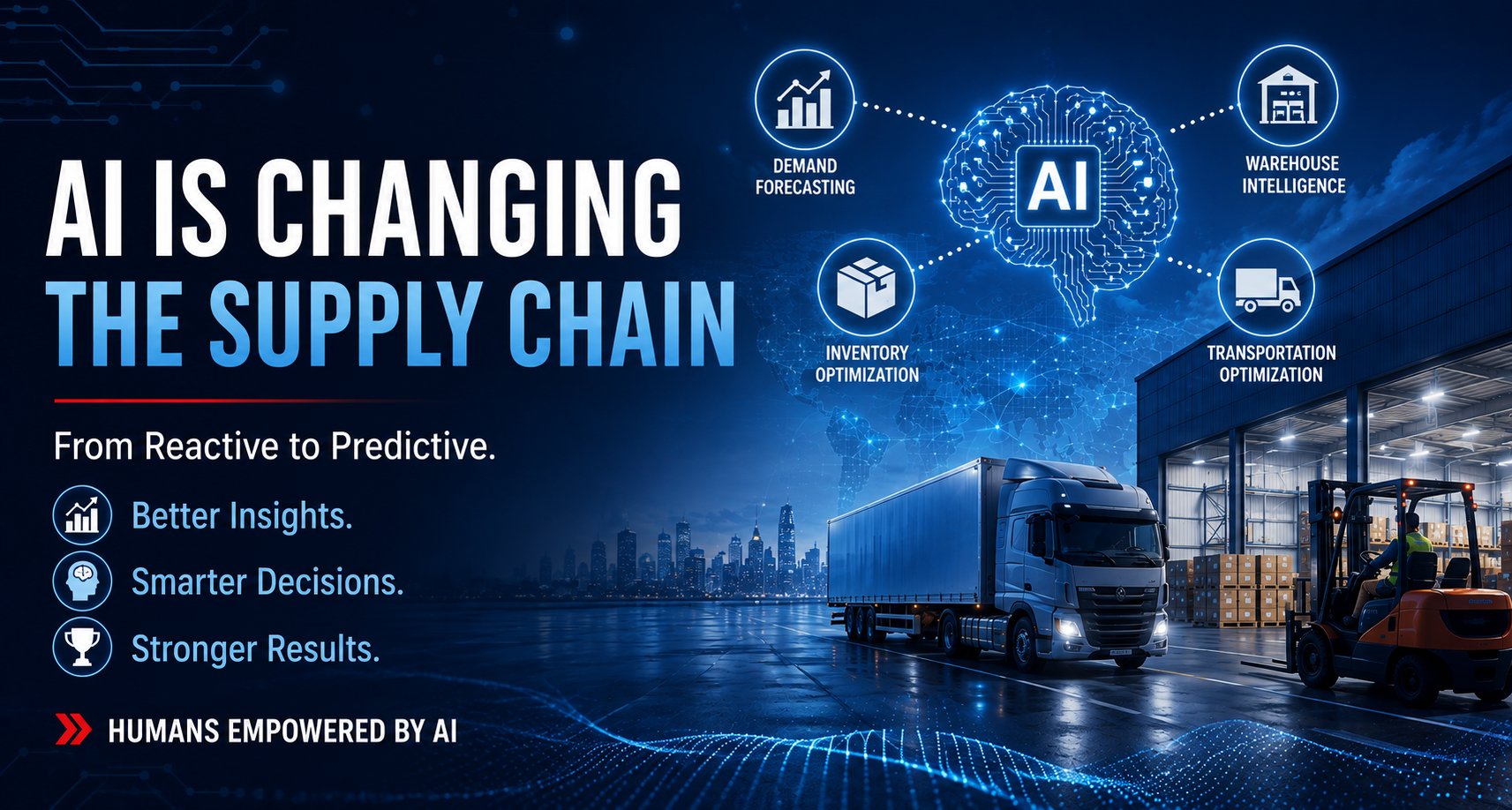
Artificial intelligence is no longer a futuristic concept discussed at technology conferences. It is quickly becoming part of the everyday reality of supply chain and logistics.
And perhaps no industry is better positioned to benefit from AI than supply chain.
Why? Because supply chains generate enormous amounts of data and require thousands of decisions every day.
Where should inventory be located?
How much should we order?
Which transportation provider should we use?
Do we have enough labor?
Should we automate?
When will a shipment arrive?
Where are our bottlenecks?
What happens if a supplier misses its delivery?
For years, supply chain professionals have answered these questions using experience, spreadsheets, software and, quite frankly, a lot of educated guesses.
AI is changing that equation.
From Reactive to Predictive
One of the most important impacts of AI is helping supply chains become more predictive rather than reactive.
Instead of simply telling us what happened yesterday, AI can analyze historical and real-time information to help determine what is likely to happen tomorrow.
Consider inventory. Traditional forecasting may rely heavily on historical sales and established formulas. AI can evaluate many more variables — including customer behavior, seasonality, lead times, market conditions and other changing factors — to identify patterns and improve forecasts.
The potential result? Less excess inventory. Fewer stockouts. Better utilization of working capital. More accurate planning.
The same concept applies to transportation, labor planning, procurement and warehouse operations.
AI Is Making Warehouses Smarter
The modern distribution center is already generating tremendous amounts of data. Warehouse management systems, scanners, sensors, cameras, robotics, conveyor systems and automation equipment continuously produce information about what is happening inside the four walls.
AI can take that information and turn it into actionable intelligence. It can help identify inefficient picking paths, determine where inventory should be positioned, recognize bottlenecks and recommend how labor should be allocated.
And when AI is combined with robotics and automation, something even more interesting happens. The warehouse doesn't simply become automated. It becomes more adaptive.
That distinction is important. Automation performs a task. AI can help determine which task should be performed, when it should happen and how it can be done most efficiently.
Transportation Is Getting Smarter, Too
Transportation has traditionally been an exercise in balancing cost, service and availability. AI is adding another dimension: continuous optimization.
Imagine a system constantly evaluating traffic, weather, carrier performance, capacity, delivery windows, fuel costs and customer requirements. Rather than developing a transportation plan and leaving it alone, AI can continuously evaluate whether a better option exists.
That can mean fewer miles, improved utilization, better service and potentially lower transportation costs.
AI Can Help Identify Supply Chain Risk Earlier
Recent supply chain disruptions taught companies an important lesson: visibility matters.
AI can monitor enormous amounts of information to identify potential risks involving suppliers, transportation networks, weather, geopolitical developments and other external factors.
It won't predict every disruption. But it may identify warning signs earlier than traditional systems. And in supply chain management, earlier information can be incredibly valuable.
If you know about a potential disruption weeks instead of days in advance, you have more options. You can source elsewhere. Increase inventory. Change transportation modes. Adjust production. Or communicate with customers before a problem becomes a crisis.
AI Won't Replace Supply Chain Professionals
This may be the most important point. AI isn't eliminating the need for experienced supply chain professionals. It is changing what those professionals can accomplish.
AI is exceptionally good at analyzing enormous amounts of information, recognizing patterns and generating recommendations. People are still needed to understand the business, challenge the assumptions, evaluate trade-offs and make decisions.
The future isn't people versus AI. It is people empowered by AI.
The Biggest Opportunity: Better Decisions
The greatest impact of AI may not be a particular robot or software platform. It may simply be better decision-making.
Every supply chain executive makes hundreds of decisions. AI can help make those decisions faster, with more information and potentially with greater accuracy.
But implementing AI simply because everyone else is doing it isn't a strategy. The right approach is to start with the business problem.
Where are we losing money? Where are we experiencing service issues? Where are we lacking visibility? Where are our people spending too much time on repetitive analysis? Where could better information lead to better decisions?
Then ask whether AI is the right tool to solve the problem.
For companies willing to approach AI strategically, the opportunity is significant. The supply chain of the future won't simply be faster or more automated. It will be more intelligent, more predictive and more responsive.
And the companies that learn how to combine AI with experienced people, sound processes and accurate data may find themselves with a significant competitive advantage.
The future of supply chain isn't humans versus AI. It's humans empowered by AI.